
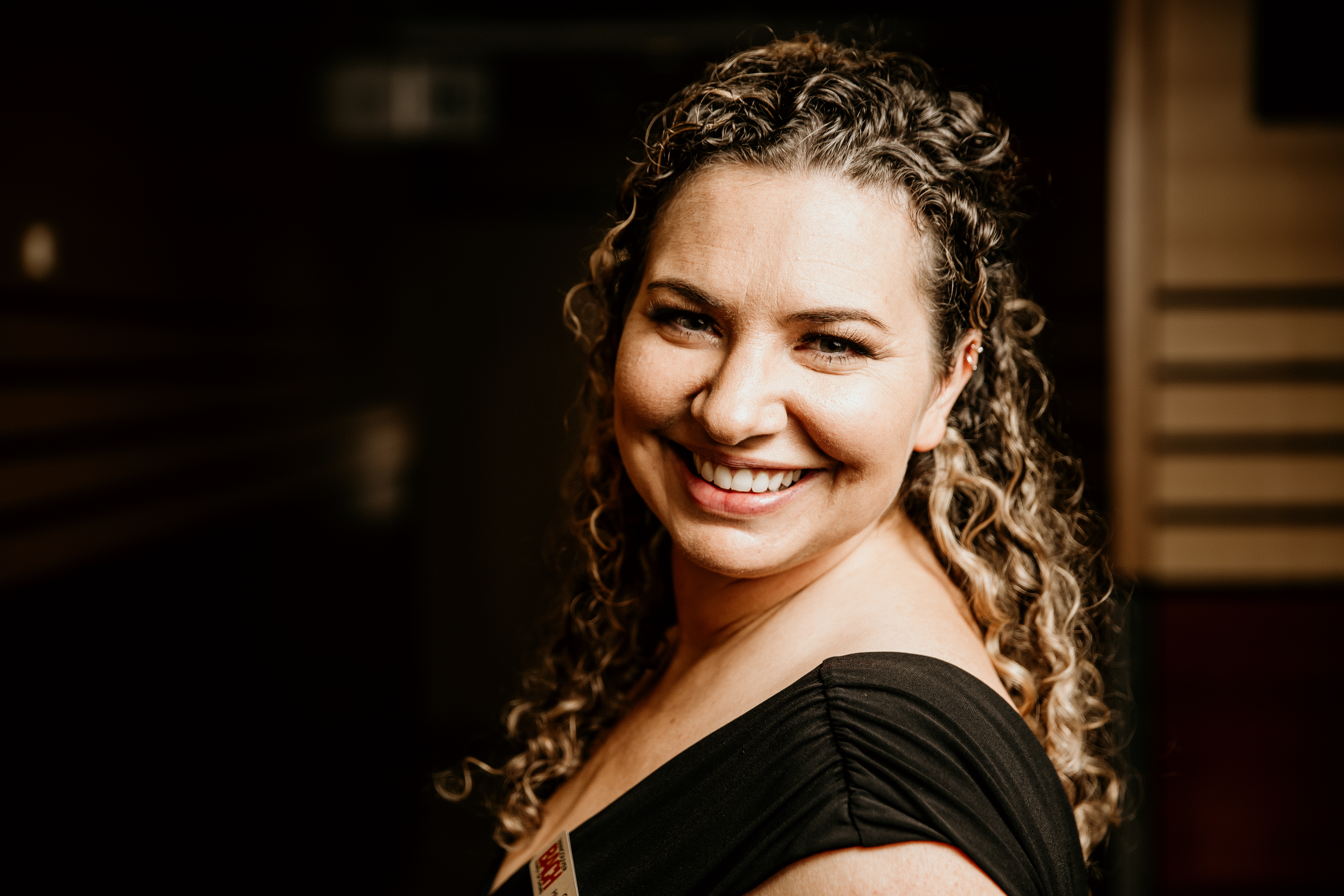
By Tabitha Brasso-Ernst for Bachstage Pass
Gillian Hunter-Gibbs is Executive Director of the Vancouver Bach Choir, an organization approaching its hundredth year. She also knows her office printer by name (RICOH, by the way)— a small detail that says a lot about how she runs things: attentive to the big picture and the people in the room at the same time.
Growing Up in the Room
Gillian has been preparing for this role since childhood, singing in the Vancouver Bach Children’s Choir under Children’s Choir Artistic Director Marisa Gaetanne.
“She was, in fact, my conductor when she was a very young woman,” Gillian says. “Very glamorous, very beautiful, VERY dynamic. And I think I was about ten years old. She was wonderful then and she’s wonderful now.”
That history shapes how she sees the job now. “Growing up in the choirs, what was the most important thing was just arriving on a Tuesday or a Thursday or whatever it was and singing and seeing my friends and making amazing music and feeling challenged and really having a very rewarding musical experience,” she says. “But I think you certainly as a child, but even as an adult singer, don’t necessarily think about what goes into even making those rehearsals happen, let alone concerts and everything else. So there’s a huge appreciation for what goes on behind the scenes now that I’m part of that.”
“Those two things together set me up quite well for coming in and making cool stuff happen,” she adds.
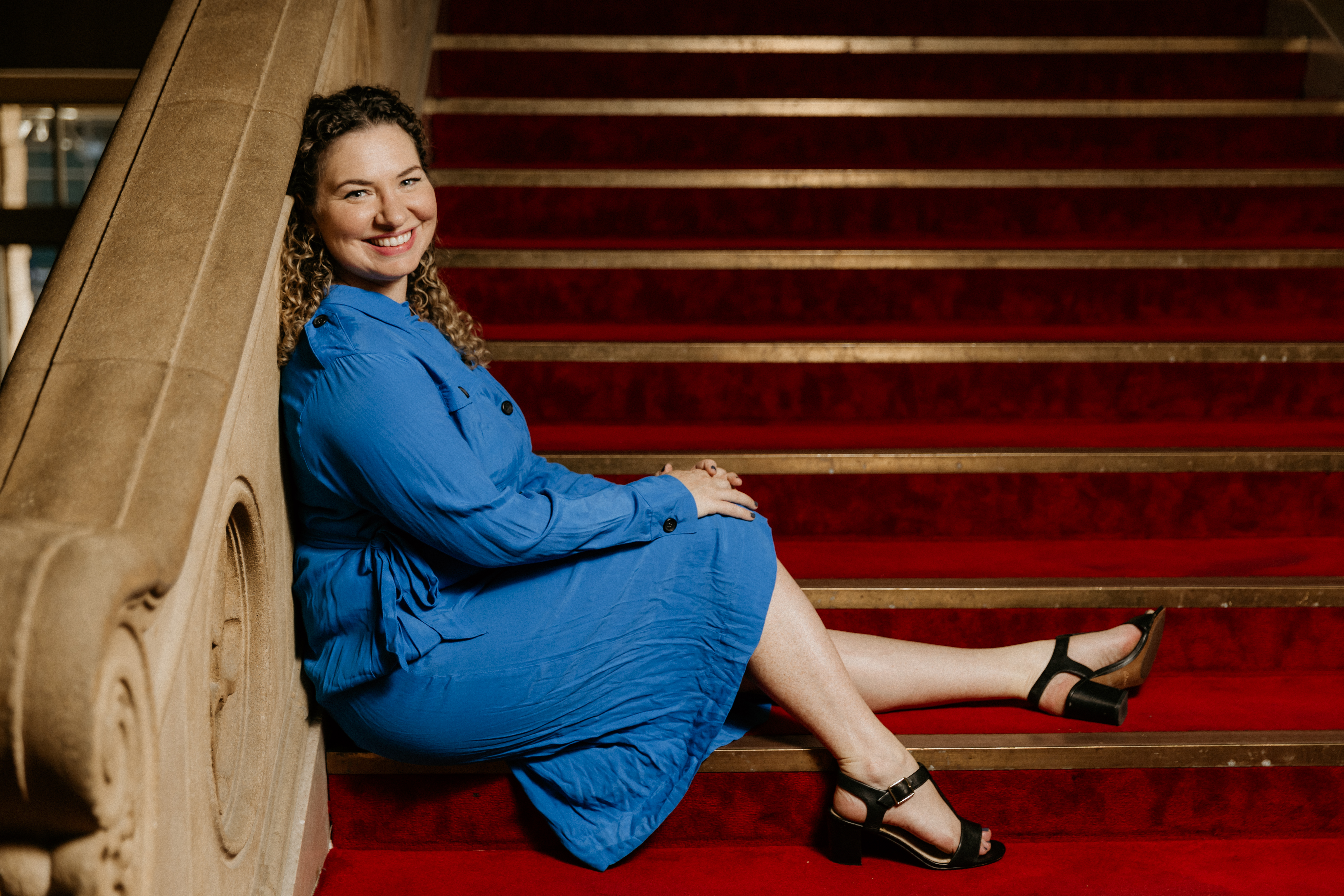
Gillian at the Orpheum. Photo courtesy of Diamond’s Edge Photography and Gillian Hunter-Gibbs.
What Counts as a Good Season
Ask an executive director what makes a season successful, and budgets are the usual answer. Gillian doesn’t stop there.
“It’s a real balancing act to feel that we’re being authentic to ourselves artistically and authentic to our history as an organization, the foundation that we are standing on, the almost 100 years of foundation of this organization,” she says. “And, you know, the great big choral works, classical choral work that everybody knows and loves, like the Messiah and Carmina Burana. There’s so much beautiful music.”
She’s equally focused on where the organization pushes forward — commissioning new work and supporting Canadian composers. “This organization has always been very good at commissioning work and being supportive of Canadian composers, but really, now more than ever, wanting to do that and to be able to support our own talent in this country and a diverse array of talent.”
She credits VBFC Artistic Director Leslie Dala directly: “Les has done an amazing job of programming in this way!”
Beyond the artistic side, she measures success by how the whole operation runs — the children’s choirs, three adult choirs, rehearsals across the city, venue partnerships, every contractor involved.
“That’s a measure of success as well, is sort of how smoothly things have gone and making sure that everybody is as happy as they can be,” she says. “And I do feel like that’s a big part of my job — on all levels — and that’s from the little kid who’s singing in choir for the first time to the singers that have been singing with our organization for 50 years.”
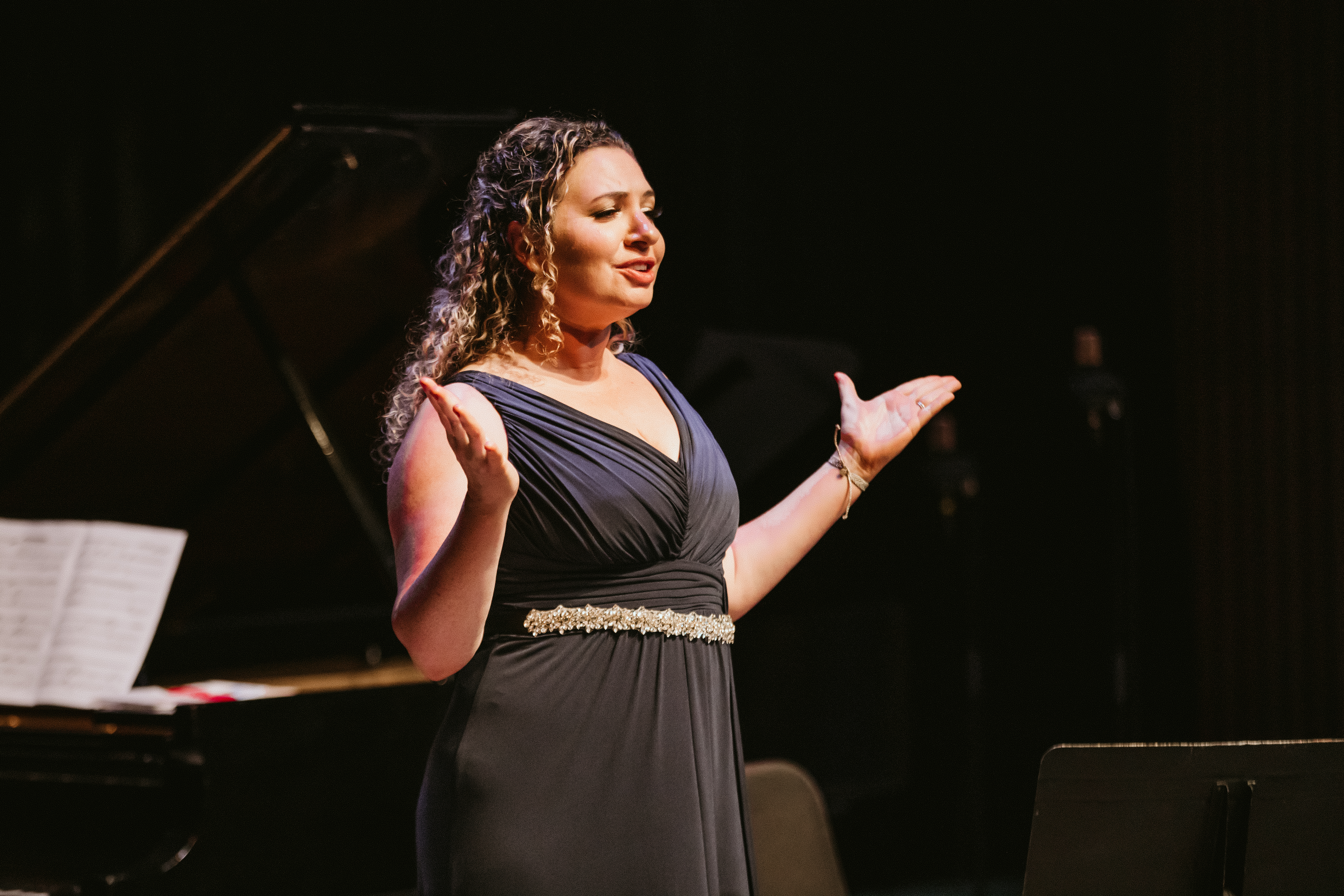
Gillian at Behind the Keys 2023. Photo courtesy of Diamond’s Edge Photography and Gillian Hunter-Gibbs.
What Kids Understand That Adults Forget
Before running the organization, Gillian built a career in early childhood music education — a thread that still runs through her work.
“The thing that I love about working with very young children is that they don’t have any walls up about anything,” she says. “They hear a pulse, they hear a rhythm that they like, and they don’t care if it’s coming from a bassoon or from a bass guitar or a drum kit. They just respond without any barriers to the joy of music.”
As kids get older, that openness gets complicated by ideas of what’s cool. “Classical music for a lot of people, even in childhood, becomes oh, I’m not into that kind of music. But young children never respond like that. They just respond to how wonderful the music is, whatever genre it is.”
Her path into the field started almost by accident, working part-time at the UBC childcare centre while she studied music. It continued in London, where she noticed a gap: orchestras were doing strong outreach with teenagers and school-age kids, but almost nothing for very young children. “So we ended up developing some projects and concerts that were geared specifically to very young children,” she says — work that eventually brought her back to Vancouver to teach early childhood music at the VSO School, and later to launch VBC’s own Piccolini program for four and five year olds.
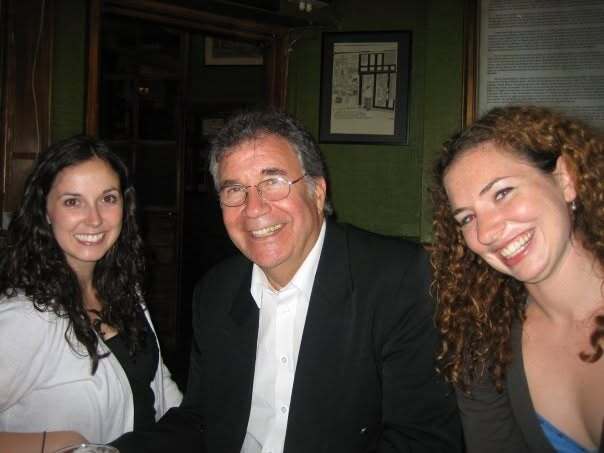
Amanda Jangula, former Artistic Director Bruce Pullan, and Gillian. Photo courtesy of Gillian Hunter-Gibbs.
Choir as a Team Sport
Gillian draws a direct line between choral singing and team sports.
“There’s something very special about that. And there’s something that when you’re doing that with a group of people, it’s more, it’s even more than just the music making. You’re really bonded with those people using your voice as your instrument,” she says. “I think for kids, getting to see children experience that joy and the bonding that that creates — I think that, for me, is what’s most special.”
She pushes the comparison further: choir is a team sport where no single star can carry the show. “The fact that the star of the choir can’t make the choir concert great by themselves — everybody has to kind of be a star,” she says. “You’re going to join an organization, you’re going to join a work team, an office somewhere. You’re going to be part of a group. You might have your specific role within that group, but everybody’s roles are important, and you’re working together for a particular goal.”
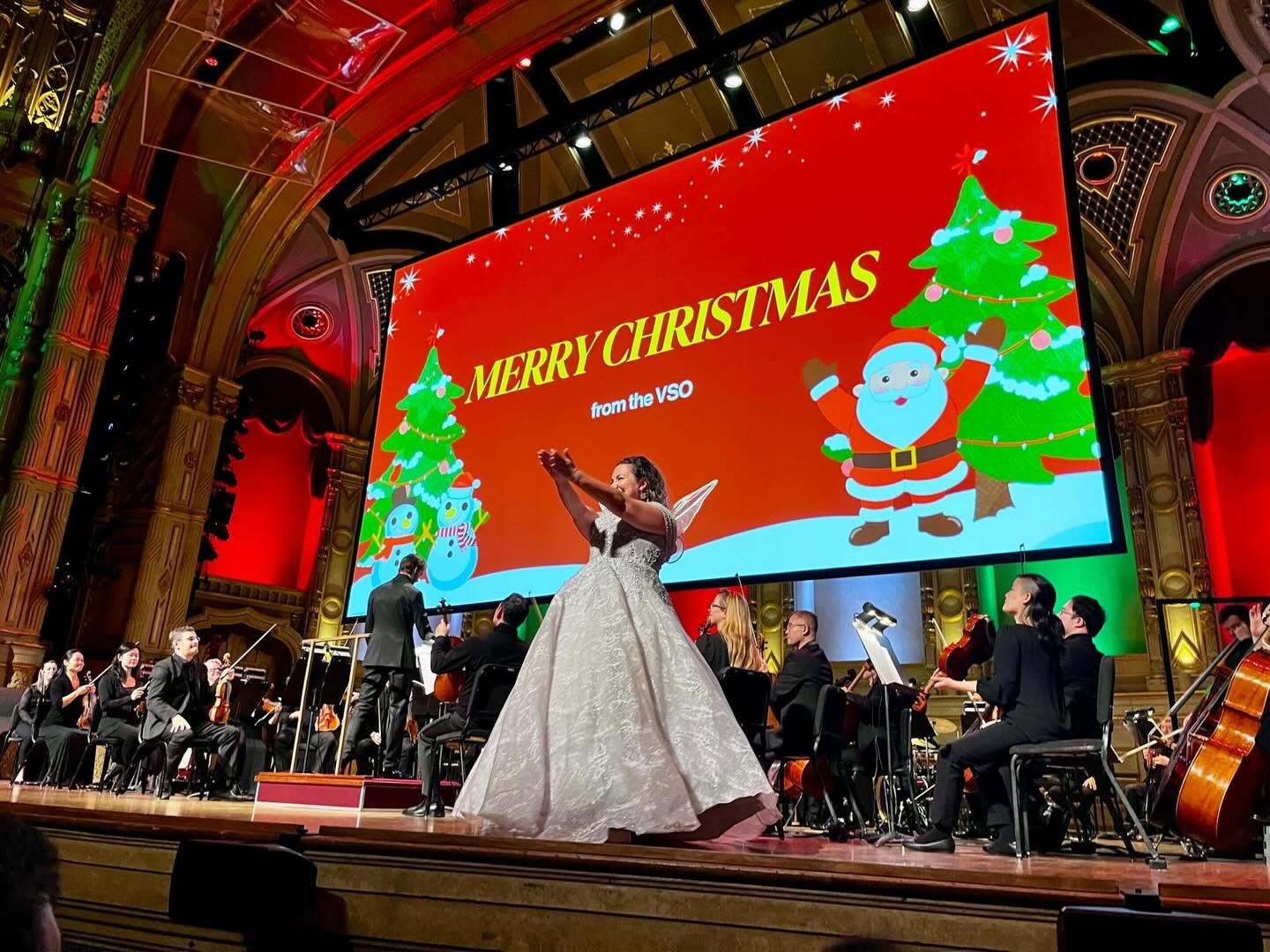
Gillian presenting The Snowman at the Orpheum with the VSO. Photo courtesy of Gillian Hunter-Gibbs.
Staying a Musician, On Purpose
Gillian still plays violin and viola — a deliberate choice, made against some resistance early in her career.
“I was studying voice, but I played violin and viola at quite a high level and I didn’t want to stop doing that,” she says of university. “I found really that there was quite a lot of resistance to that thing that I had created for myself, of doing lots of different things and playing instruments and singing, from teachers who wanted me to choose. And I would say that I’m very glad that I never chose.”
She sees that ongoing practice as central to how she leads. “It really makes me a much more authentic manager, and that musicians have trust in me because they feel like I’m one of them, and that I’m not sort of sitting on a pedestal, in an office without a connection to what it feels like to be in the real world, being a performer,” she says.
It also drives a frustration she’s carried through her career — the divide between management and artists. “I’ve heard and felt that from the management side, where it sometimes seems like, well, the musicians don’t understand. And I’ve certainly felt it from the musician side, of well, management just doesn’t understand,” she says. “I really strive to understand both. And so that’s really important to me.”
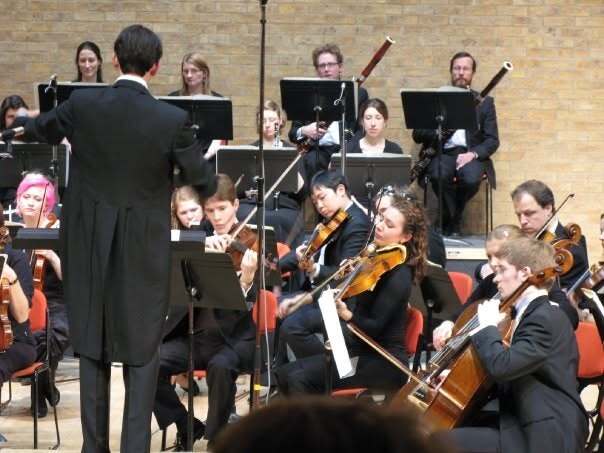
Gillian playing violin in an orchestra in Cambridge, UK. Photo courtesy of Gillian Hunter-Gibbs.
Music and Memory
Asked if there’s one piece she returns to, Gillian says no — but describes something more interesting: music she played constantly as a kid without thinking twice, hitting differently decades later.
“Growing up playing the violin, I played Pachelbel’s Canon in D ten bazillion times,” she says. “It wasn’t, I don’t think it felt like a special piece at that time in my life. You play it at every single wedding, everybody says, oh gosh, that piece is so overplayed. But I recently played it with some wonderful musicians and I thought, this is such a beautiful piece of music. There’s a reason it’s played at every single wedding. It’s so beautiful.”
She’s seen that connection between music and memory in healthcare and care-home settings too. “Somebody who was maybe not even sort of responsive to anything else in their environment, but then they hear a song that they knew as a child and loved, and they just light up, and they’re tapping their feet,” she says. “It’s just incredible.”
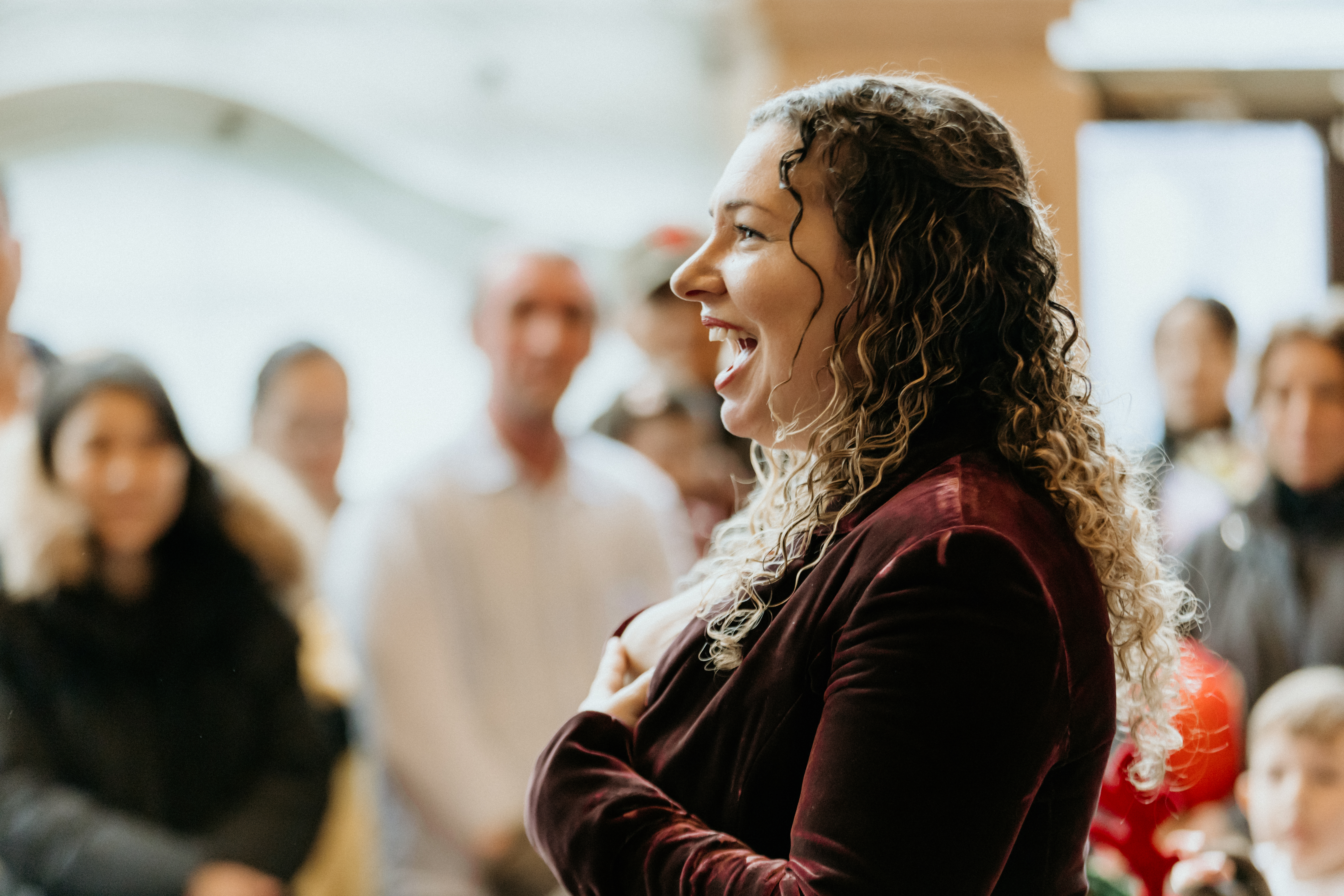
Gillian at the Orpheum. Photo courtesy of Diamond’s Edge Photography and Gillian Hunter-Gibbs.
Bringing London Home
Gillian spent over a decade living and working in the UK, which reshaped how she thinks about where music belongs.
“I used to say the work that I was doing over there for orchestras was sort of anything that is not on the concert platform,” she says, describing community projects that reached schools, daycares, hospitals, and care settings. Coming back to Vancouver, she didn’t expect the gap she found. “It’s not dependent on where in the world it is. It’s not dependent on a city like London. It’s actually just about skilled musicians working in unexpected settings.”
That shapes how she sees the choir’s role today. “The communities that are created across all from the children all the way through to all of our adult choirs — this sort of sense of belonging and community that’s created every Tuesday night, or Wednesday afternoon, or whenever people are coming for their weekly rehearsals — has to be of equal, if not larger, importance than what happens on the concert stage.”
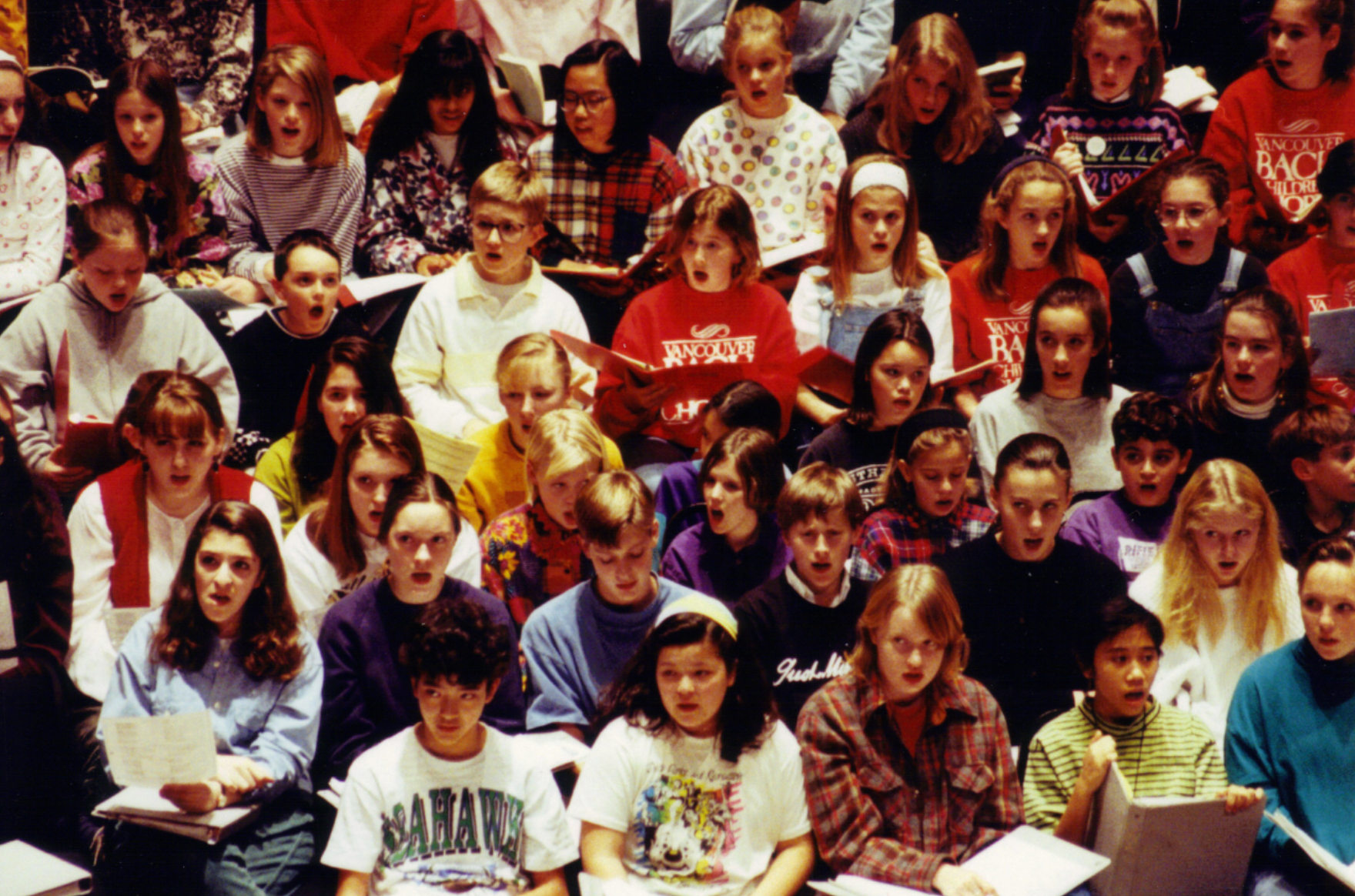
Gillian as a chorister during rehearsals for Christmas with the Bach Choir, 1992. Photo courtesy of Gillian Hunter-Gibbs.
The Legacy Question
Asked how she’d want the organization to remember her, Gillian took a moment before answering.
“I hope that what I am continuing to bring to this organization is a great love of what I do,” she says. “I’ve never really understood people having a job that’s not something they are obsessed with. I’m just obsessed with what I do. I truly love it. And I love the people involved.”
She traces that back to her own childhood in the choirs, and to Bruce Pullan, who founded the children’s choirs and sent a generation of young singers — including her — toward Cambridge and the UK. “It shaped so many of our lives growing up to such a huge extent, that I feel like it’s an honour and a privilege, but also such a duty, to create that environment for people today in this organization,” she says.
Empathy as the Whole Point
Gillian refuses to separate being kind from being effective.
“I hope that even when things are very difficult — and I know they always deeply affect me personally, because I want to make sure that they’re dealt with with empathy always,” she says. “Everybody’s just human, right? People make mistakes and people are going through hard times, and you never know what somebody’s going through.”
She knows that approach doesn’t move as fast as a harder-edged leadership style might. “You might not get the effects as quickly as other people. You might not be able to achieve the things as quickly as other people could when they’re doing things in different ways,” she says. “But I would rather it took a long time, or things had to move a little slower, because it was because you really wanted to give that the best chance you could.”
That philosophy extends to the smallest tasks. Gillian still sets up chairs at rehearsals and puts up banners at events. “I truly, truly believe in getting my hands dirty all the time,” she says. “If there’s a job that has got to get done, I will happily do that job. What better way to show everybody in the organization the importance of every bit of what it takes to keep the ship moving and to keep climbing and to keep growing, than to know what it takes.”
It’s the same instinct behind her habit of saying yes to nearly everything — from partnerships with Vancouver Opera and the VSO to projects far outside the traditional classical music world.
“I like to say yes to things because everything is a potential opportunity, right? And so when you say no, it just closes that down, and nothing could ever come out of it,” she says. “You just have to say yes.”
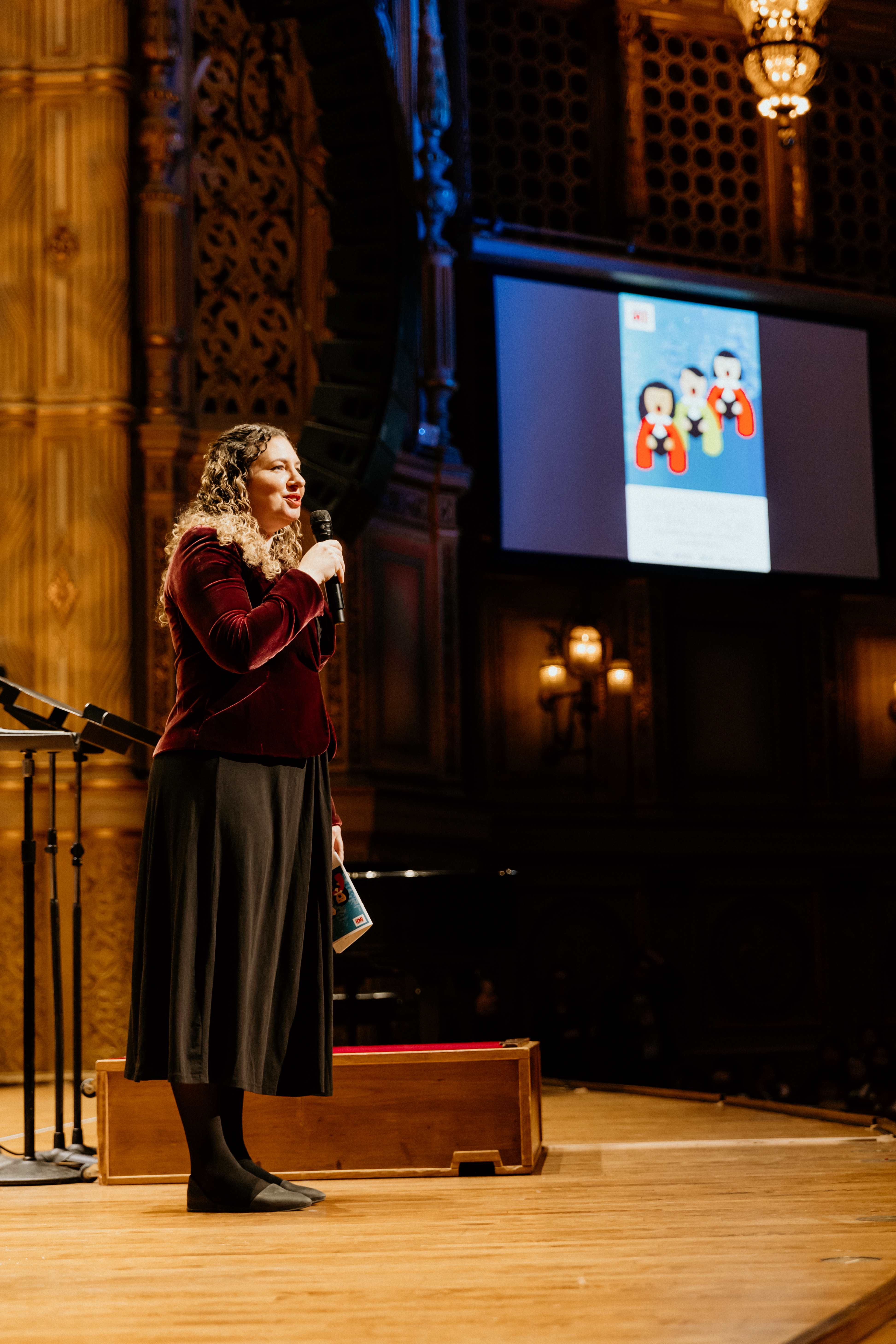
Gillian presenting the pre-show speech for Christmas with the Bach Choir at the Orpheum. Photo courtesy of Diamond’s Edge Photography and Gillian Hunter-Gibbs.